Highest
Home energy in Massachusetts: prices, who sells you power and what is open
Most electricity sales go through competitive suppliers, net metering has caps that matter, and the state's federally funded home rebates were still awaiting launch on the state's page. Here is how each part works.
By VoltHearth Editorial Team Updated 7 min read
- Electricity price
- 30.41¢ per kWh
- Natural gas price
- $25.06 per Mcf
- Pick your supplier
- Yes (68% of sales)
- Net metering
- Yes, with utility caps
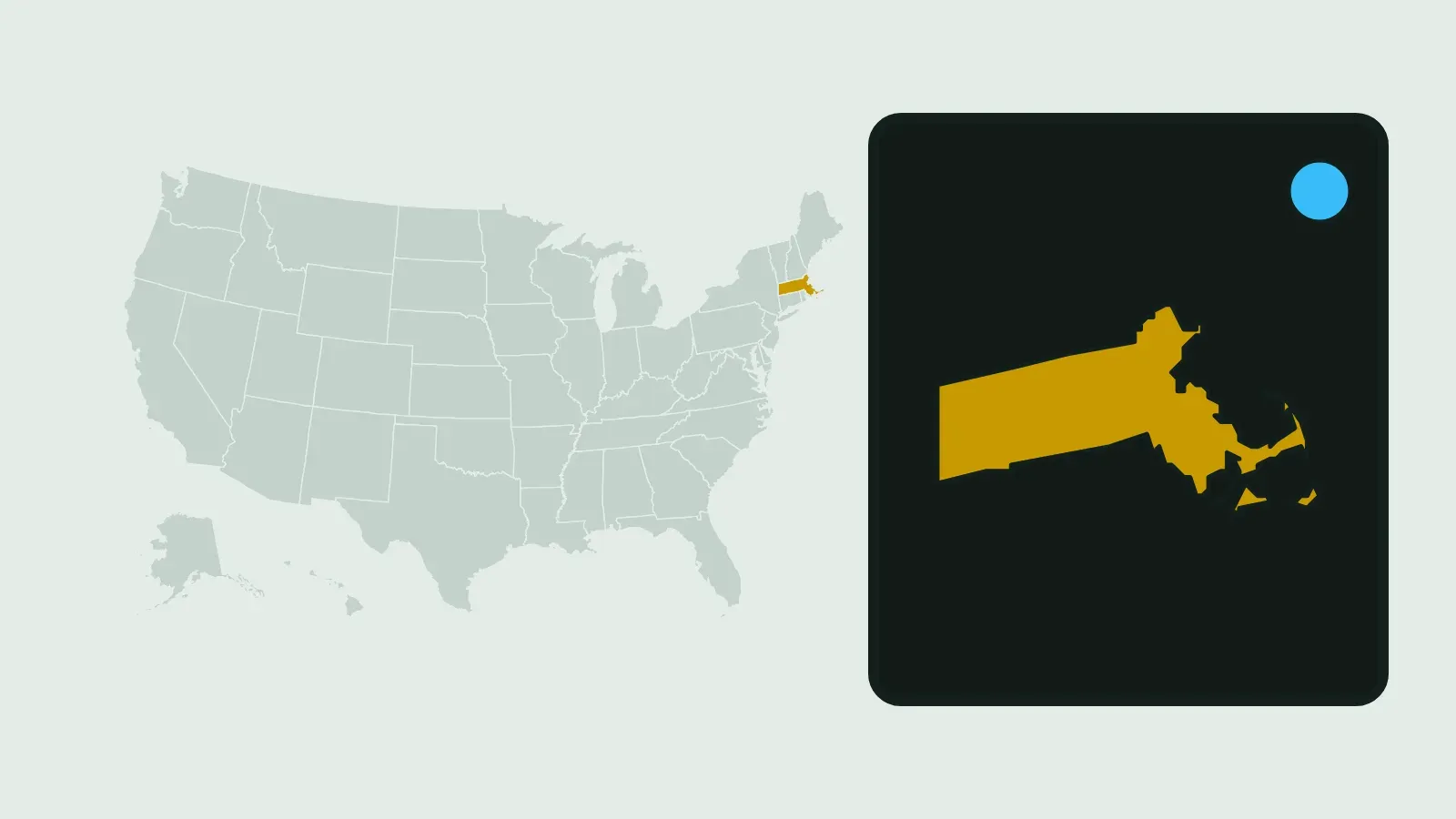
At a glance
Massachusetts households paid an average of 30.41¢ per kWh for electricity in 2025, well above the national average, and $25.06 per thousand cubic feet for natural gas, also above it. EIA's 2024 profile shows about 68% of retail electricity sales as energy-only sales, the mark of retail choice. Customers of Eversource, National Grid and Unitil may net meter, within caps of 7% (private) and 8% (public) of each utility's peak load. The state's HER and HEAR rebates had not launched on the state's page, which carries no update date.
Massachusetts at a glance
What Massachusetts households pay for electricity and gas
The U.S. Energy Information Administration (EIA) reports statewide averages: total residential revenue divided by kilowatt-hours sold, so delivery charges and fees are inside the figure. Your own rate depends on your utility, supplier, plan and season, so treat these as a yardstick, not a quote.
| Energy | Mass. 2025 | Mass. 2024 | U.S. 2025 |
|---|---|---|---|
| Electricity (¢ per kWh) | 30.41 | 29.35 | 17.23 |
| Natural gas (dollars per Mcf) | 25.06 | 21.90 | 15.34 |
At 30.41¢, a month with 1,000 kWh of use comes to about $304. Massachusetts electricity rose about 4% between 2024 and 2025 (29.35¢ to 30.41¢) and ran about 77% above the U.S. average. Gas rose about 14% in a year and ran about 63% above the U.S. average per Mcf. One Mcf holds roughly 10.37 therms, so $25.06 per Mcf is about $2.42 per therm; the kWh, therm and ccf guide explains the units on your bill.
Who sells you electricity
EIA's 2024 state profile splits Massachusetts retail electricity sales into energy-only sales, about 68% of the total, and full-service sales, about 32%. Energy-only sales are the category that marks retail choice: a supplier sells the power while your utility delivers it. The Department of Public Utilities (DPU) names Eversource, National Grid and Unitil as the regulated electric companies. Some towns are served by municipal light plants instead.
Plans differ on fixed or variable price, contract length and cancellation terms. The retail choice guide shows how to compare them on the total bill at your own usage instead of the headline rate.
Solar panels and what the grid pays you
If you are a customer of Eversource, National Grid or Unitil, you may net meter, according to the DPU's guide. Any technology up to 60 kW qualifies, and residential solar is usually in the 60 kW or smaller class. You are billed on net use each month, and excess generation becomes a dollar credit on your bill. The DPU says the credits never expire and roll over to the next billing period, except for cap-exempt facilities serving on-site load.
- Caps: private caps are 7% and public caps 8% of each utility's highest historical peak load. As of December 2024, Eversource's private cap was 408.24 MW and National Grid's was 359.191 MW. Once a utility fills its cap, new customers who need that space cannot net meter.
- What credits offset: supply and delivery charges, but not fixed customer charges, system benefit charges or demand charges, among others.
- Credit value: it varies by utility, rate class and facility type, so the DPU's example of about 27¢ per kWh for one Eversource customer in August 2024 is an illustration, not your rate.
- 2025 and 2026 changes: the rooftop cap-exempt exception ended in March 2025; the no-cap-allocation threshold rose from 10 kW to 25 kW; and transfers of accrued credits to other accounts are allowed through December 31, 2026.
The federal tax credit for rooftop solar ended for systems finished after December 31, 2025. What happened to 25C and 25D explains what is left. The DPU also lists an open proceeding, D.P.U. 23-20, that may change how the Single Parcel Rule applies.
Home energy rebates
The Massachusetts Department of Energy Resources (DOER) planned two federally funded programs. Its page lists $73,086,125 for the Home Efficiency Rebate program (HER, the whole-home program DOE calls HOMES) and $72,809,130 for the Home Electrification and Appliance Rebate program (HEAR). It says DOER had submitted the initial HER applications to DOE and that DOE approval of a State Implementation Blueprint is required before programs launch. HEAR is planned to be delivered through Mass Save for households at or below 60% of median income, with a moderate-income initiative at 61% to 80%.
The page carries no update date. Its latest dated items are a March 2024 public session and a timeline that expected funding by the end of 2024 and implementation in early 2025, so it may be out of date and does not confirm that either program is open. Per-household maximums are not listed. Check DOER and Mass Save before you count on a rebate. How the programs work is in the HOMES and HEAR guide.
Who to call
- Electricity and net metering: the Department of Public Utilities regulates net metering. Contact your utility first for interconnection issues, then file the DPU dispute form.
- Rebates: the Department of Energy Resources, and Mass Save for the utility-delivered programs.
- Solar cap space: MassACA, the entity the DPU created to handle net metering cap allocations.
What is distinctive about energy in Massachusetts
Massachusetts splits home efficiency help by who serves you. DOER names Mass Save as the channel for HEAR, and its HER plan includes a separate program, MLP-HER, for homes with one to four units in the 40 municipal light plant communities that DOER describes as not served by Mass Save. Find out which side of that line your address is on before you plan work. The utility rebates guide covers utility programs in general.
Quick answers
Can I choose my electricity provider in Massachusetts?
Yes in most cases. EIA's 2024 profile shows about 68% of retail electricity sales were energy-only sales, the category that marks retail choice. Some towns are served by municipal light plants, so check which applies to your address.
Does Massachusetts have net metering?
Yes, for customers of Eversource, National Grid and Unitil, within caps of 7% (private) and 8% (public) of each utility's peak load. Credits are dollar credits that roll over month to month.
Are Massachusetts home energy rebates available now?
The state's page does not say they are open and carries no update date. It lists HER as submitted and awaiting DOE approval and HEAR as planned through Mass Save. Check DOER and Mass Save before you start work.
Why are Massachusetts electricity prices so high?
EIA's 2025 residential average was 30.41¢ per kWh against 17.23¢ nationally. EIA's averages do not break down the reasons, and your bill shows separate supply and delivery lines worth comparing.
Sources
- EIA — Electric Power Annual, Table 2.10, average price by state
- EIA — Average residential natural gas price by state
- EIA — Massachusetts electricity profile
- Mass.gov — Net metering guide (Department of Public Utilities)
- Mass.gov — DOER federal funding updates and information
Prices are EIA statewide averages. Facts on this page were checked against these sources on November 19, 2026. Rebate programs and utility policies change; confirm with your utility, DOER and Mass Save before you act.
Read next
-
Bill guide
Retail choice plans
What you can switch when you pick an electricity supplier, plan types, and how to compare offers.
-
Bill guide
Net metering
How exported solar power is credited on a bill, how net billing differs, and where to find your rule.
-
State reading
Maine
27.69¢ per kWh; standard offer or a competitive supplier; net energy billing; HEAR partly open.