Highest
Home energy in Maine: prices, who sells you power and what is open
You can stay on the standard offer or pick a competitive supplier, rooftop solar earns kilowatt-hour credits, and the state's home energy rebates are open only in part. Here is how each part works.
By VoltHearth Editorial Team Updated 7 min read
- Electricity price
- 27.69¢ per kWh
- Natural gas price
- $18.95 per Mcf (2024)
- Pick your supplier
- Yes (43% of sales)
- Net metering
- Net energy billing
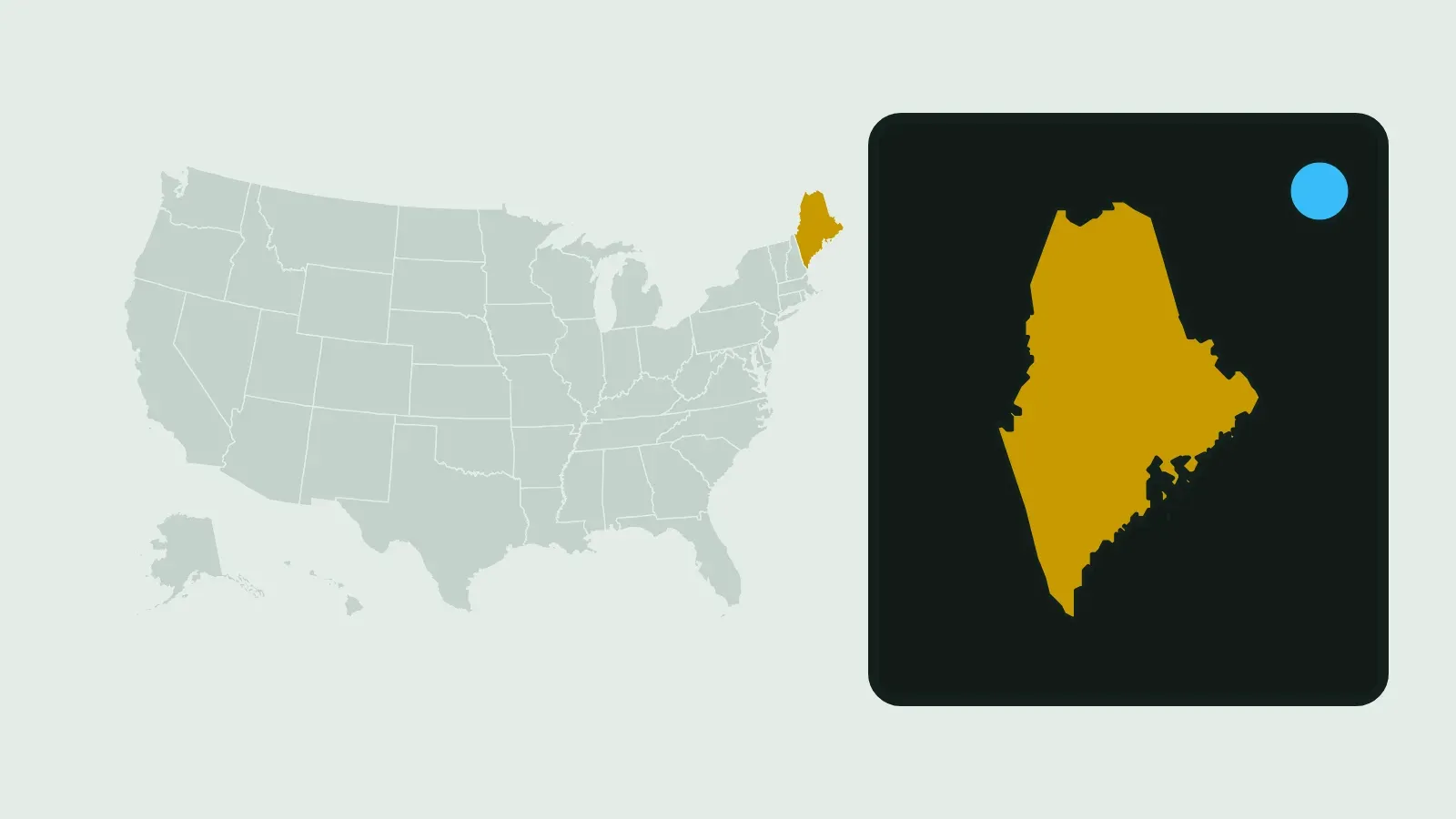
At a glance
Maine households paid an average of 27.69¢ per kWh for electricity in 2025, about 61% above the national average and up about 14% from 2024. EIA did not report a 2025 natural gas price for Maine; the 2024 figure was $18.95 per thousand cubic feet. You can stay on the standard offer, which the Public Utilities Commission sets each year, or choose a competitive supplier. Rooftop solar customers earn kilowatt-hour credits under net energy billing. Of the state's two rebate programs, HEAR is live for two building types and HER is not yet open.
Maine at a glance
What Mainers pay for electricity and gas
The U.S. Energy Information Administration (EIA) reports statewide averages: total residential revenue divided by kilowatt-hours sold, so delivery charges and fees are inside the figure. Your own rate depends on your utility, supplier, plan and season, so treat these as a yardstick, not a quote.
| Energy | Maine 2025 | Maine 2024 | U.S. 2025 |
|---|---|---|---|
| Electricity (¢ per kWh) | 27.69 | 24.29 | 17.23 |
| Natural gas (dollars per Mcf) | Not reported | 18.95 | 15.34 |
At 27.69¢, a month with 1,000 kWh of use comes to about $277. Maine electricity rose about 14% between 2024 and 2025 (24.29¢ to 27.69¢). EIA did not report a 2025 gas price for Maine. The 2024 figure of $18.95 per Mcf was about 31% above the 2024 U.S. average of $14.50, and works out to about $1.83 per therm at 10.37 therms per Mcf. The kWh, therm and ccf guide explains the units on your bill.
Who sells you electricity
Maine separates delivery from supply. The Public Utilities Commission (PUC) sets a standard offer rate through a bidding process, and customers who do not choose a supplier stay on it. The rate changes each January 1. The Maine Office of the Public Advocate lists the 2026 standard offer as 12.721¢ per kWh for Central Maine Power (CMP) customers and 12.954¢ for Versant (Bangor Hydro) customers. That covers supply only, so it is not comparable with the 27.69¢ all-in average above.
- Competitive electricity providers: you can contract with one instead. The Public Advocate's page listed CMP-area offers from 13.99¢ to 24.19¢ per kWh, on fixed terms of 6 to 24 months or on variable rates. Rates can change without notice.
- Renewals: contact your supplier before a contract ends. The page warns that you may be extended automatically at a higher or variable rate.
- Not everywhere: a footnote on that page says no competitive providers were serving the Versant - Maine Public district as of November 2023.
EIA's 2024 state profile shows about 43% of Maine retail sales as energy-only sales, the category that marks retail choice. The retail choice guide shows how to compare plans on the total bill at your own usage.
Solar panels and what the grid pays you
Maine's version of net metering is called net energy billing (NEB), governed by Public Law 2019, chapter 478 and later amendments and by the PUC's Chapter 313 rules. For residential customers the relevant option is the kWh Credit Program, which provides kilowatt-hour credits on your bill and is open to all electric utility customers, including homeowners. The dollar-credit Tariff Rate Program is for non-residential customers. Rooftop panels on your own property qualify, and projects must be renewable generators under 5 MW.
In 2025 the Legislature passed LD 1777, which changes how larger and community solar projects are compensated. The Public Advocate's summary says the bill exempts rooftop and cooperatively owned solar from the changes. That is an advocacy summary, not the bill text, so confirm with the PUC. The federal tax credit for rooftop solar ended for systems finished after December 31, 2025; what happened to 25C and 25D explains what is left.
Home energy rebates
Maine's federally funded rebates have two programs, and Efficiency Maine Trust administers HEAR, according to the Governor's Energy Office page. Efficiency Maine's own page lists them. HEAR, the electrification program, has $35.7 million and is live in two forms: one for new affordable multifamily housing and one for single-family manufactured homes, for income-eligible households, supporting efficient heat pump systems. HER, the home efficiency program DOE calls HOMES, has $35.9 million, is listed as conditionally awarded and is not yet open. Its target is existing multifamily buildings that reach at least 35% energy savings.
The page says DOE published new Program Notices on June 1, 2026 that revise program rules, and that Efficiency Maine is reviewing them. No per-household amounts or HER application dates are listed. A single-family home that is not a manufactured home does not appear in either open program on that page. How the programs work is in the HOMES and HEAR guide.
Who to call
- Electricity: the Maine Public Utilities Commission sets the standard offer and runs net energy billing.
- Supplier and rate questions: the Maine Office of the Public Advocate lists standard offer and competitive supplier rates.
- Rebates: Efficiency Maine Trust, 866-376-2463.
What is distinctive about energy in Maine
Maine has more than one delivery territory. The Public Advocate's tables name CMP and Versant (Bangor Hydro), and a footnote refers to a Versant - Maine Public district, so the standard offer and the list of suppliers depend on where your address is. EIA lists natural gas as Maine's primary source of electricity generation; in 2024 net generation was about 14.7 million megawatt-hours against retail sales of about 11.3 million. Start with your bill to see which utility delivers to you; the electric bill guide shows where.
Quick answers
Can I choose my electricity provider in Maine?
Yes. You can stay on the standard offer, which the PUC sets through bidding each year, or choose a competitive electricity provider. Availability differs by territory, so check the Public Advocate's supplier page for your utility.
Does Maine have net metering?
Maine uses net energy billing. Residential customers use the kWh Credit Program, and unused credits expire after 12 months. LD 1777 (2025) changed rules for larger and community projects; confirm with the PUC how it applies to you.
Are Maine home energy rebates available now?
In part. HEAR is live for new affordable multifamily housing and manufactured homes. HER is conditionally awarded and not yet open. Check Efficiency Maine before you start work you hope a rebate will cover.
Why did Maine's electricity price jump in 2025?
EIA's residential average rose from 24.29¢ to 27.69¢ per kWh, about 14%. EIA's averages do not break down the reasons. Your bill's supply and delivery lines show which part changed for you.
Sources
- EIA — Electric Power Annual, Table 2.10, average price by state
- EIA — Average residential natural gas price by state
- EIA — Maine electricity profile
- Maine Office of the Public Advocate — Electricity supply
- Maine Public Utilities Commission — Net energy billing
- Maine Office of the Public Advocate — LD 1777 information sheet
- Efficiency Maine — IRA home energy rebates
- Maine Governor's Energy Office — Home energy rebates
Prices are EIA statewide averages; EIA did not report a 2025 gas price for Maine. Facts on this page were checked against these sources on November 19, 2026. Supplier rates and rebate programs change; confirm with your utility and Efficiency Maine before you act.
Read next
-

Bill guide
Retail choice plans
What you can switch when you pick an electricity supplier, plan types, and how to compare offers.
-

Bill guide
Net metering
How exported solar power is credited on a bill, how net billing differs, and where to find your rule.
-
State reading
Massachusetts
30.41¢ per kWh; supplier choice; net metering with caps; HER and HEAR not confirmed open.