Moderate
Home energy in Alabama: prices, who sells you power and what is open
You buy power from the utility that serves your address, the state has no net metering policy for rooftop solar, and the home energy rebates are still under development.
By VoltHearth Editorial Team Updated 5 min read
- Electricity price
- 16.09¢ per kWh
- Natural gas price
- $17.56 per Mcf
- Pick your supplier
- No, utility-set rates
- Net metering
- None offered
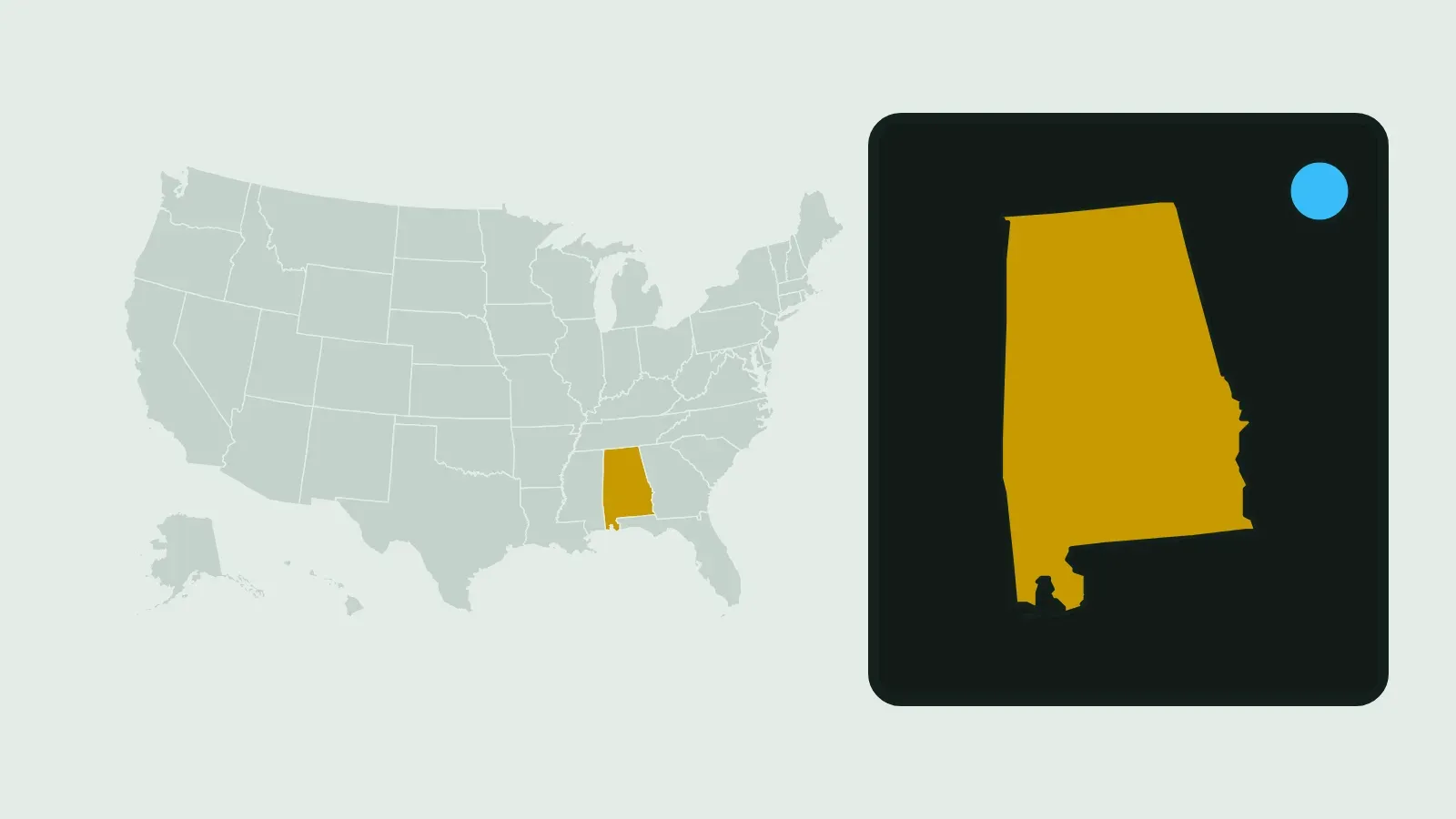
At a glance
Alabama households paid an average of 16.09¢ per kWh for electricity in 2025, below the national average, and $17.56 per thousand cubic feet for natural gas, above it. EIA data show no energy-only electricity suppliers selling in Alabama in 2024, so your rate comes from the utility that serves you. The state does not offer net metering, and the state's HOMES and HEAR rebates are listed as under development with no launch date.
Alabama at a glance
What Alabamians pay for electricity and gas
The U.S. Energy Information Administration (EIA) reports statewide averages: total residential revenue divided by kilowatt-hours sold, so delivery charges and fees are inside the figure. Your own rate depends on your utility, rate plan and season, so treat these as a yardstick, not a quote.
| Energy and year | Alabama | U.S. |
|---|---|---|
| Electricity 2025 (¢ per kWh) | 16.09 | 17.23 |
| Electricity 2024 (¢ per kWh) | 15.18 | 16.48 |
| Natural gas 2025 (dollars per Mcf) | 17.56 | 15.34 |
| Natural gas 2024 (dollars per Mcf) | 18.63 | 14.50 |
At 16.09¢, a month with 1,000 kWh of use comes to about $161. Alabama electricity rose about 6% between 2024 and 2025 (15.18¢ to 16.09¢) and still sat about 7% below the U.S. average. Natural gas went the other way on both counts: Alabama's average fell about 6% in a year, yet it ran about 14% above the U.S. figure. One Mcf holds roughly 10.37 therms, so $17.56 per Mcf is about $1.69 per therm; the kWh, therm and ccf guide explains the units on your bill.
Who sells you electricity
Alabama households do not shop for an electricity supplier. EIA's 2024 Alabama profile lists energy-only provider sales of zero, which means every kilowatt-hour was sold by a full-service utility that also delivers it. Which utility that is depends on your address, and your bill names it.
- Alabama Power: the only investor-owned electric utility in the state, according to the Alabama Public Service Commission (PSC). The PSC's Electricity Policy Division oversees its rates and services.
- Co-ops and municipal systems: the PSC says cooperatives and municipal systems are exempt from state regulation, so their rates are set locally.
- Tennessee Valley Authority: the PSC says it does not regulate TVA.
Because several kinds of utility serve the state, two neighbors can pay different rates for the same usage. See rate structures explained for how fixed charges, energy charges and tiers add up on a residential bill.
Solar panels and what the grid pays you
DSIRE, the state incentive database, says Alabama does not offer net metering policies. Net metering is the rule in many states that credits excess solar power at the retail rate. Where it does not exist, what you receive for exports, and what you pay to stay connected, comes from your own utility's tariff.
Alabama Power's Rate Rider RGB, issued under a PSC order dated November 5, 2021 and in effect from April 2022 billings, sets a Capacity Reservation Charge of $5.41 per kilowatt for secondary service. It applies to the nameplate capacity of on-site, non-emergency generation for customers who take firm back-up power under rates that include the residential Rate FD. As an illustration of the arithmetic only, a 5 kW system at that rate adds 5 × $5.41 = $27.05 a month. The rider text does not say how exported energy is credited, so ask for that rate in writing.
Home energy rebates
The Alabama Department of Economic and Community Affairs (ADECA) runs the state's share of two federally funded programs: HOMES, rebates for whole-home efficiency work, and HEAR, rebates for electric appliances and equipment. ADECA lists the Inflation Reduction Act home energy rebates as under development and says the launch date has not been determined. The page shows no update date and no state-set rebate amounts.
Federal rules allow up to $8,000 for HOMES and up to $14,000 per household for HEAR, but a state sets its own limits, and Alabama had not published them on its ADECA page. ADECA asks anyone who wants updates to email rebates@adeca.alabama.gov. Until the programs open, treat any contractor's offer of Alabama rebate money as ahead of the state. How the programs work elsewhere is in the HOMES and HEAR guide.
What the commission does not oversee
The PSC's reach is narrower than many households assume. It regulates Alabama Power. It does not regulate co-ops, municipal systems or TVA. If a rate or fee on your bill looks wrong, start with your own utility, then check whether the PSC has authority over that utility before you file a complaint. The electric bill guide shows which lines to check first.
Who to call
- Electricity: the Alabama Public Service Commission, Electricity Policy Division, for Alabama Power.
- Natural gas: the Alabama Public Service Commission also lists a Gas division on its website.
- Rebates: the Alabama Department of Economic and Community Affairs (ADECA).
Quick answers
Can I choose my electricity provider in Alabama?
No. EIA's 2024 profile shows no energy-only supplier sales in Alabama, so your utility both sells and delivers your power. Your bill names the utility that serves your address.
Does Alabama have net metering?
DSIRE says Alabama does not offer net metering policies. Your utility's tariff sets any export credit and any charge on solar customers, such as Alabama Power's $5.41 per kilowatt Capacity Reservation Charge under Rate Rider RGB.
Are Alabama home energy rebates available now?
Not according to ADECA's page, which lists them as under development with no launch date. Check ADECA before you start work you hope a rebate will cover.
Why is my Alabama gas price higher than the U.S. average?
EIA's 2025 average for Alabama households was $17.56 per Mcf against $15.34 nationally. Delivery charges, distance from supply and fixed monthly charges all feed a utility's average, and your own rate depends on the utility serving your area.
Sources
- EIA — Electric Power Annual, Table 2.10, average price by state
- EIA — Average residential natural gas price by state
- EIA — Alabama electricity profile 2024
- Alabama Public Service Commission — Electricity
- Alabama Power — Rate Rider RGB, supplementary, back-up or maintenance power
- DSIRE — Alabama programs
- ADECA — Inflation Reduction Act home energy rebates program
Prices are EIA statewide averages. Facts on this page were checked against these sources on November 19, 2026. The ADECA page shows no update date. Rebate programs and utility tariffs change; confirm with your utility and ADECA before you act.
Read next
-
Bill guide
Net metering
How exported solar power is credited on a bill, how net billing differs, and where to find your rule.
-
Credits and rebates
HOMES and HEAR rebates
State-run DOE rebates and the May 2026 rule changes. Status differs by state.
-
State reading
Georgia
14.74¢ per kWh; Georgia Power rates frozen through 2028; HEAR rebate reopened in limited form.