Low
Home energy in Washington: prices, net metering and rebates
Washington electricity costs less than the national average, but both prices rose in 2025. Net metering depends on your utility, and a state-funded appliance rebate runs while the federal ones wait.
By VoltHearth Editorial Team Updated 6 min read
- Electricity price
- 13.17¢ per kWh
- Natural gas price
- $17.62 per Mcf
- Pick your supplier
- Limited; mostly utility
- Net metering
- Yes, until a 4% cap
At a glance
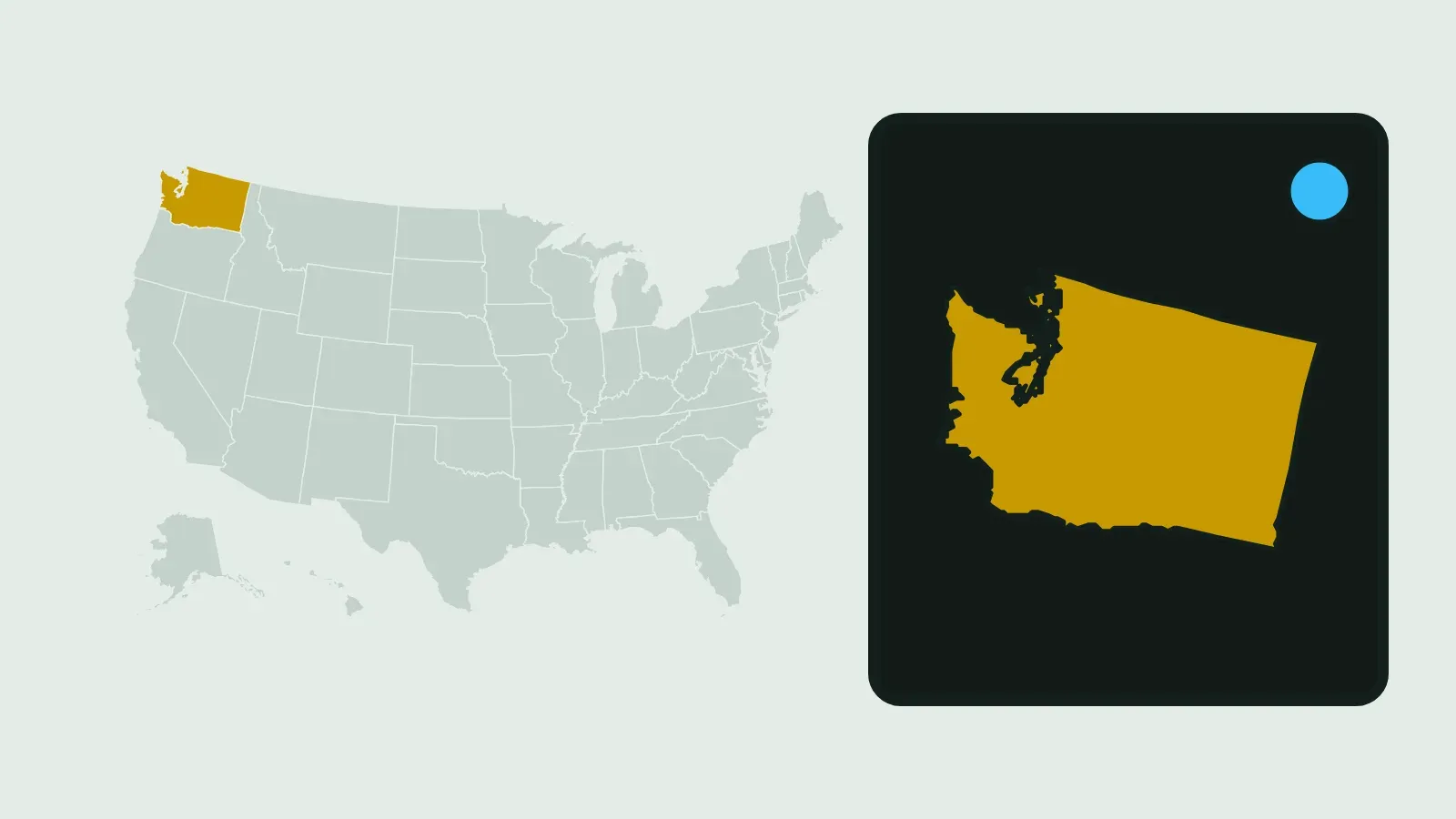
Washington households paid an average of 13.17¢ per kWh for electricity in 2025, about 24% below the national average, and $17.62 per thousand cubic feet for natural gas, about 15% above it. Both rose from 2024. Most electricity comes from full-service utilities, some investor-owned and some consumer-owned. State law requires net metering until a utility reaches a 4% cap, and four utilities had moved to a different rate by the January 2026 report. The federal HOMES and HEAR rebates had not launched.
Washington at a glance
What Washingtonians pay for electricity and gas
The U.S. Energy Information Administration (EIA) reports statewide averages: total residential revenue divided by kilowatt-hours sold, so delivery charges and fees are inside the figure. Your own rate depends on your utility, so treat these as a yardstick, not a quote.
| Energy | Washington 2025 | Washington 2024 | U.S. 2025 |
|---|---|---|---|
| Electricity (¢ per kWh) | 13.17 | 11.90 | 17.23 |
| Natural gas (dollars per Mcf) | 17.62 | 12.72 | 15.34 |
At 13.17¢, a month with 1,000 kWh of use comes to about $132. Washington electricity rose about 11% between 2024 and 2025 (11.90¢ to 13.17¢), and the gas average rose about 39%, from $12.72 to $17.62 per Mcf. One Mcf holds roughly 10.37 therms, so $17.62 per Mcf is about $1.70 per therm. The kWh, therm and ccf guide explains the units on your bill.
Who sells you electricity
EIA's 2024 state electricity profile for Washington lists 89,981,629 MWh of retail sales. Of that, 2,307,812 MWh, about 2.6%, came from energy-only providers; the rest came from full-service providers, meaning utilities that deliver and sell the power. The figures cover all customer types, not only homes, so they do not show whether your address can shop.
Washington's utilities come in two groups. Investor-owned utilities file their rates and net metering proposals with the Utilities and Transportation Commission (UTC). Consumer-owned utilities answer to their own governing bodies. Your bill names yours. The rate structures guide explains what the parts of a bill mean.
Solar panels and what the grid pays you
Washington's net metering law, chapter 80.60 of the Revised Code of Washington, sets a threshold for each utility: cumulative net metering capacity equal to four percent of the utility's 1996 peak demand. A utility that reaches the cap before June 30, 2029 may adopt a standard rate or tariff that departs from the law's credit rules. Investor-owned utilities send the proposal to the UTC, and consumer-owned utilities send it to their governing bodies.
The WSU Energy Program tracks this. Its January 2026 net metering report lists four utilities that had implemented a policy that departs from the statute: Franklin County PUD, Kittitas County PUD, Orcas Power and Light, and PacifiCorp. Ask your utility which rule applies to a new system, and what the export credit is.
Home energy rebates
The Washington State Department of Commerce will run the federally funded HOMES and HEAR programs. In October 2024 it reported awards of $83,102,750 for HOMES and just over $165 million across both programs. Its program page now shows the work at the "program operation preparation" step, with launch waiting for approval from the Department of Energy. It gives no launch date and says rebates are not retroactive, so work done before launch is not covered.
Commerce also says it is evaluating updated federal guidance, DOE program notices 26-1 and 26-2. The latest dated item on that page is a September 16, 2025 announcement that Commerce chose Guidehouse as the rebate administrator. The HOMES and HEAR guide explains how the programs work in states where they have launched.
A state-funded appliance rebate is already running
Separate from the federal programs, Commerce funds a state Home Electrification and Appliance Rebates (HEAR) program through local administrators. Commerce reports about $39.3 million awarded to 40 administrators from its 2025 biennial and 2026 supplemental budgets. Eligible households are at or below 150% of Area Median Income for their county. Equipment includes heat pumps for heating and cooling, induction cooking, heat pump water heaters, heat pump dryers and electrical panel or wiring upgrades, if it meets ENERGY STAR or AHRI certification. The page lists no per-household maximum; ask the administrator for your area. If your area is not listed, the contract is not final or no one was awarded to serve it.
Who to call
- Investor-owned utility rates and net metering proposals: the Washington Utilities and Transportation Commission.
- Consumer-owned utilities: your utility's governing body, such as a public utility district board.
- Net metering reports by utility: the WSU Energy Program.
- Rebates: the Washington State Department of Commerce, at HomeRebates@Commerce.wa.gov.
Quick answers
Can I choose my electricity supplier in Washington?
Only in limited cases. EIA shows about 2.6% of Washington's 2024 retail electricity sales, across all customer types, coming from energy-only providers. The utility on your bill sets your rate in most cases.
Does Washington have net metering?
Yes, by state law, until a utility's net metering reaches four percent of its 1996 peak demand. A utility that reaches the cap before June 30, 2029 may adopt a successor rate. The WSU Energy Program's January 2026 report lists four that had.
Are Washington home energy rebates available now?
The federal HOMES and HEAR programs are not open. Commerce's page shows them waiting on DOE approval to launch. A separate state-funded HEAR program runs through local administrators for households at or below 150% of Area Median Income.
Why did Washington gas prices jump in EIA's 2025 average?
EIA's 2025 average for Washington households was $17.62 per Mcf, up from $12.72 in 2024, against $15.34 nationally. EIA's table gives the figures, not the cause, and your own rate depends on your gas utility.
Sources
- EIA — Electric Power Annual, Table 2.10, average price by state
- EIA — Average residential natural gas price by state
- EIA — Washington state electricity profile (retail sales by provider type, 2024)
- WSU Energy Program — Net metering in Washington
- Washington Commerce — Inflation Reduction Act home energy rebates program
- Washington Commerce — DOE approves Washington's application for IRA home rebates (October 2024)
- Washington Commerce — State Home Electrification and Appliance Rebates (HEAR)
Prices are EIA statewide averages. Facts on this page were checked against these sources on November 19, 2026. Net metering terms and rebate programs change; confirm with your utility and the Department of Commerce before you act.
Read next
-
Bill guide
Net metering
How exported solar power is credited on a bill, how net billing differs, and where to find your rule.
-
Credits and rebates
HOMES and HEAR rebates
State-run DOE rebates and the May 2026 rule changes. Status differs by state.
-
State reading
Oregon
15.46¢ per kWh; no household supplier choice; statewide net metering; rebates not open yet.