Moderate
Home energy in Virginia: prices, net metering and what is open
Virginia electricity prices sit below the national average. Most customers buy from their utility, net metering is set by State Corporation Commission rules, and the state's home rebates were not yet available.
By VoltHearth Editorial Team Updated 6 min read
- Electricity price
- 15.28¢ per kWh
- Natural gas price
- $16.79 per Mcf
- Pick your supplier
- Limited; mostly utility
- Net metering
- Yes, SCC rules
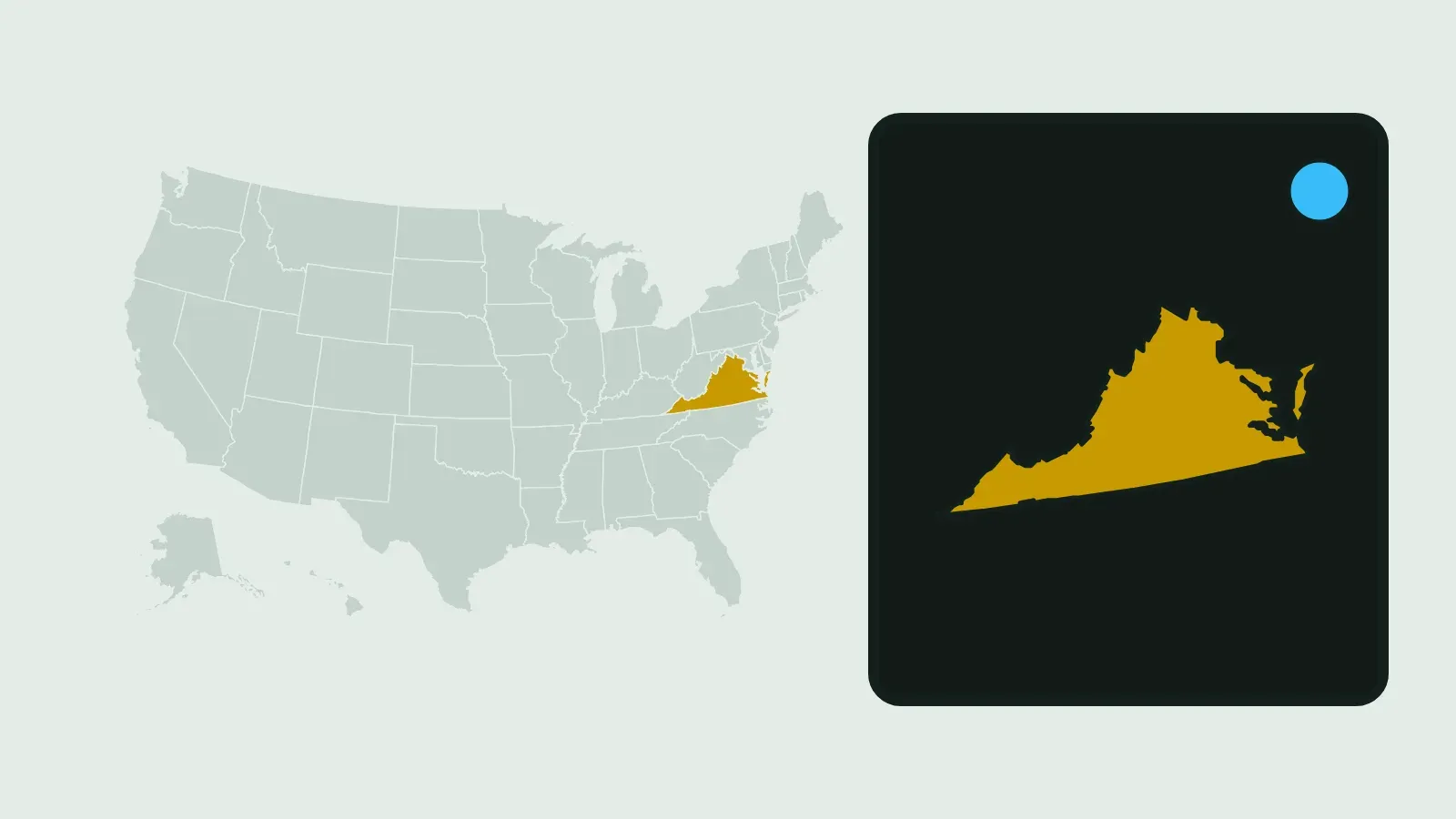
At a glance
Virginia households paid an average of 15.28¢ per kWh for electricity in 2025, about 11% below the national average, and $16.79 per thousand cubic feet for natural gas, about 9% above it. Most customers buy electricity from their utility; EIA shows about 4% of 2024 retail sales coming from energy-only providers. Net metering is governed by State Corporation Commission (SCC) rules, and Virginia Energy said on October 13, 2026 that its HOMES and HEAR rebates were not available yet.
Virginia at a glance
What Virginians pay for electricity and gas
The U.S. Energy Information Administration (EIA) reports statewide averages: total residential revenue divided by kilowatt-hours sold, so delivery charges and fees are inside the figure. Your own rate depends on your utility and plan, so treat these as a yardstick, not a quote.
| Energy | Virginia 2025 | Virginia 2024 | U.S. 2025 |
|---|---|---|---|
| Electricity (¢ per kWh) | 15.28 | 14.41 | 17.23 |
| Natural gas (dollars per Mcf) | 16.79 | 15.40 | 15.34 |
At 15.28¢, a month with 1,000 kWh of use comes to about $153. Virginia electricity rose about 6% between 2024 and 2025 (14.41¢ to 15.28¢). One Mcf of gas holds roughly 10.37 therms, so $16.79 per Mcf is about $1.62 per therm. The kWh, therm and ccf guide explains the units on your bill.
Who sells you electricity
EIA's 2024 state electricity profile for Virginia lists 138,044,772 MWh of retail sales. Of that, 5,989,398 MWh, about 4%, came from energy-only providers and the rest from full-service providers, meaning utilities that deliver and sell the power. The figures cover all customer types, not only homes. Whether your address can shop is a question for your utility and the SCC, because eligibility rules differ by customer and territory.
For most households the answer is that the utility on your bill sets the price. The SCC's net metering rules describe three kinds of supplier: investor-owned utilities, cooperatives and competitive suppliers. The retail choice guide shows how to compare plans where choice exists, and the rate structures guide explains the parts of a utility bill.
Solar panels and what the grid pays you
Virginia's net energy metering rules are in the SCC's regulations (20 VAC 5-315), last revised in an order effective March 15, 2021. Under those rules, unused credits carry forward subject to limits, and payment for excess generation depends on the supplier type. In May 2024 the SCC ordered Appalachian Power and Dominion to file new net metering proposals, covering monthly charges, compensation for the benefits of customer generators, a netting interval and the 6% net metering cap. Appalachian Power's petition was due by September 2, 2024 and Dominion's by May 1, 2025.
News and advocacy reports say the SCC kept Dominion's annual netting structure in a May 2026 order and kept most of Appalachian Power's rules in 2025, with a change in how future customers are paid for yearly surplus. Those reports are not the orders, which were not among the sources checked, so read your utility's current net metering tariff before you sign a solar contract.
- Electric cooperatives: state law sets residential systems at up to 20 kW, an overall cap of 2% of the co-op's system peak, and a monthly standby charge for residential systems over 10 kW.
- Small plug-in solar: a 2026 amendment excludes small portable solar generation devices from the co-op net metering section, effective January 1, 2027.
The federal tax credit for rooftop solar ended for systems finished after December 31, 2025, so the credit terms in your tariff carry more of the payback now. See what happened to 25C and 25D, and run your numbers in the solar payback calculator.
Home energy rebates
Virginia Energy will run two federally funded programs: HOMES for whole-home efficiency work and HEAR for electric appliances. Its FAQ, as of October 13, 2026, says neither is available yet. Virginia Energy submitted updated application materials to the Department of Energy (DOE) in September 2026, and launch depends on DOE approval. It "cannot provide an estimated date."
- HOMES: up to $8,000 per household for projects with at least 20% modeled savings. The office is evaluating higher levels.
- HEAR: up to $14,000 per household in upfront rebates, with caps per appliance or upgrade. HEAR cannot be retroactive.
- Proposed budgets: about $75.6 million for HOMES and $75.2 million for HEAR, subject to DOE approval.
Until then, the FAQ points to Virginia Energy Connect, the Weatherization Assistance Program and utility efficiency programs. Do not sign anything tied to a rebate that has not launched. The HOMES and HEAR guide explains the programs.
Data centers and the grid
In October 2024 the SCC announced a technical conference on how growing numbers of "hyperscale" power users, such as data centers, affect utilities, ratepayers and the grid (Case No. PUR-2024-00144). The Commission said it would consider whether to create a tariff framework for these large customers and whether certain transmission and generation costs should be assigned directly to a new large-use customer class. The announcement does not say how rates for homes will change, so the cost of the outcome for your bill is not known from that source.
Who to call
- Electricity rates and net metering rules: the State Corporation Commission, which also approves co-op standby charge methods and sets purchase rates for co-op net metering.
- Rebates and energy programs: Virginia Energy, the state energy agency, through its Virginia Energy Connect platform.
- Your own bill or tariff: your utility, which can name the rate schedule that applies to you.
Quick answers
Can I choose my electricity supplier in Virginia?
Only in limited cases. EIA shows about 4% of Virginia's 2024 retail electricity sales, across all customer types, coming from energy-only providers. Most customers buy from the utility on their bill. Ask your utility or the SCC whether your address can shop.
Does Virginia have net metering?
Yes. It runs under SCC regulations (20 VAC 5-315), and the SCC reviewed the rules for Appalachian Power and Dominion in 2025 and 2026. The terms depend on your utility's current tariff.
Are Virginia home energy rebates available now?
Not on Virginia Energy's October 13, 2026 update. HOMES and HEAR were waiting on DOE review of the state's application, with no estimated date. Check the Virginia Energy FAQ before you start work you hope a rebate will cover.
How does Virginia gas compare with the U.S. average?
EIA's 2025 average for Virginia households was $16.79 per Mcf against $15.34 nationally. Your own rate depends on the gas utility serving you.
Sources
- EIA — Electric Power Annual, Table 2.10, average price by state
- EIA — Average residential natural gas price by state
- EIA — Virginia state electricity profile (retail sales by provider type, 2024)
- Virginia SCC — Order amending net energy metering regulations, Case No. PUR-2020-00195 (March 2, 2021)
- Virginia SCC — Order on future net energy metering proceedings, Case No. PUR-2024-00047 (May 6, 2024)
- Code of Virginia § 56-594.01 — Net energy metering, electric cooperatives
- Virginia Energy — Consumer energy rebates FAQ (status as of October 13, 2026)
- Virginia SCC — Commission home page (hyperscale technical conference notice)
- Southern Environmental Law Center — Press release on the SCC's Dominion order (May 22, 2026)
- Cardinal News — Rooftop solar rules for future Appalachian Power customers (September 4, 2025)
Prices are EIA statewide averages. Facts on this page were checked against these sources on November 19, 2026. The two news and advocacy items are reports about SCC orders, not the orders themselves. Net metering terms and rebate programs change; confirm with your utility, the SCC and Virginia Energy before you act.
Read next
-
Bill guide
Net metering
How exported solar power is credited on a bill, how net billing differs, and where to find your rule.
-
Credits and rebates
HOMES and HEAR rebates
State-run DOE rebates and the May 2026 rule changes. Status differs by state.
-
State reading
West Virginia
15.39¢ per kWh; utility supplies power; fair-value net metering; HOMES pilot launched Aug. 2026.