Low
Home energy in Oklahoma: prices, who sells you power and what is open
Oklahoma households pay utility-set rates, a state rule covers rooftop solar up to 300 kW, and the federally funded home energy rebates have no active program or launch date yet.
By VoltHearth Editorial Team Updated 6 min read
- Electricity price
- 13.21¢ per kWh
- Natural gas price
- $14.38 per Mcf
- Pick your supplier
- No, utility-set rates
- Net metering
- Yes, up to 300 kW
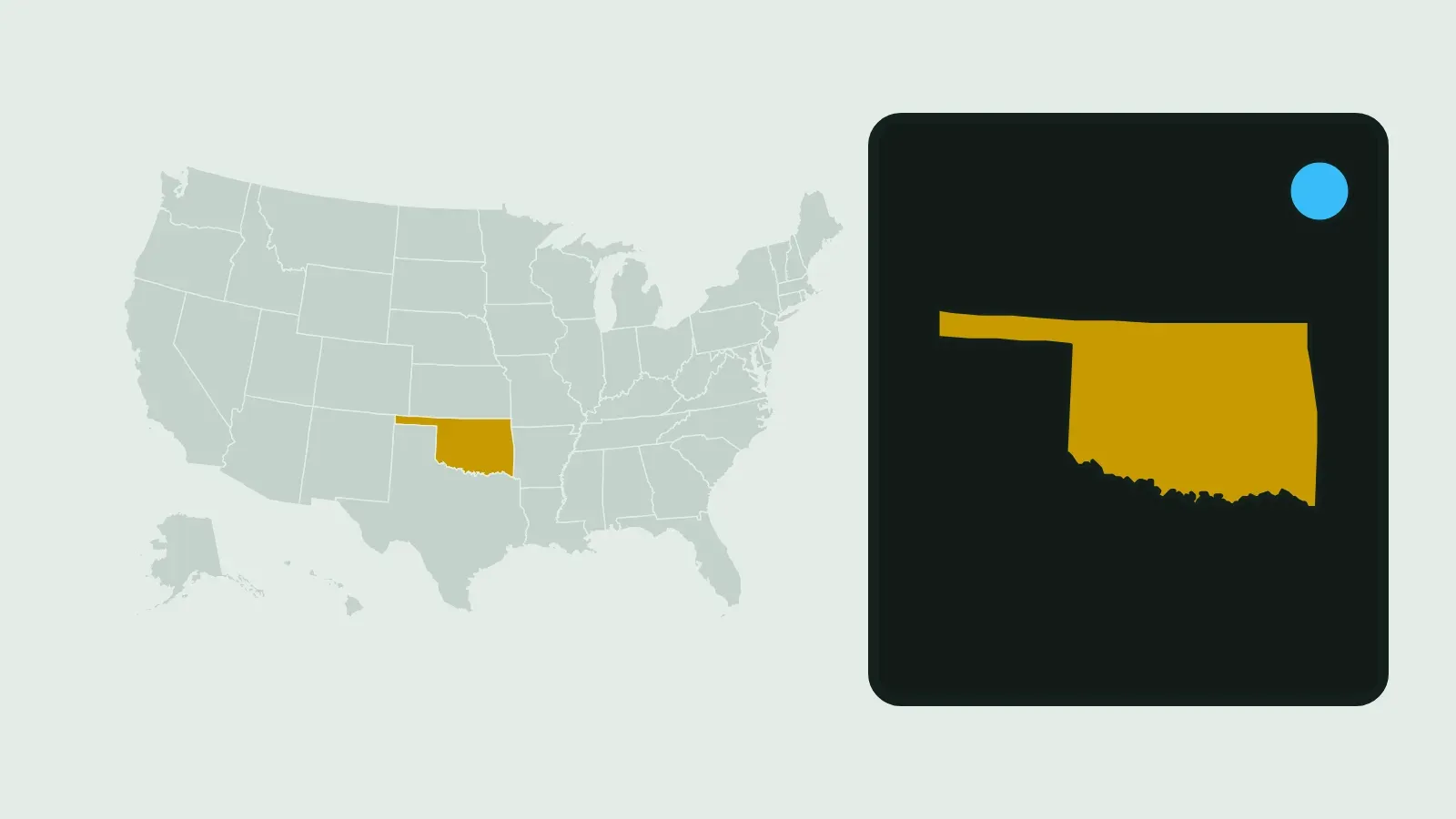
At a glance
Oklahoma households paid an average of 13.21¢ per kWh for electricity in 2025, well below the national average, and $14.38 per thousand cubic feet for natural gas, a little below it. You buy power from the utility that serves your address, and the Corporation Commission sets rates for the three investor-owned utilities. A state rule credits home solar, and the Department of Commerce said it has no active HOMES or HEAR rebate program.
Oklahoma at a glance
What Oklahomans pay for electricity and gas
The U.S. Energy Information Administration (EIA) reports statewide averages: total residential revenue divided by kilowatt-hours sold, so delivery charges and fees are inside the figure. Your own rate depends on your utility, rate schedule and season, so treat these as a yardstick, not a quote.
| Energy | Oklahoma, 2025 and 2024 | U.S., 2025 and 2024 |
|---|---|---|
| Electricity (¢ per kWh) | 13.21 and 12.24 | 17.23 and 16.48 |
| Natural gas (dollars per Mcf) | 14.38 and 13.99 | 15.34 and 14.50 |
At 13.21¢, a month with 1,000 kWh of use comes to about $132.10. Oklahoma electricity rose about 8% between 2024 and 2025 (12.24¢ to 13.21¢) and stayed about 23% below the U.S. average. Gas rose about 3% and ran about 6% below the U.S. average. One Mcf holds roughly 10.37 therms, so $14.38 per Mcf is about $1.39 per therm; the kWh, therm and ccf guide explains the units on your bill.
Who sells you electricity
The Oklahoma Corporation Commission says it regulates prices and service reliability of three investor-owned electric utilities: Liberty Utilities, Oklahoma Gas and Electric (OG&E) and Public Service Company of Oklahoma (PSO). Those rates are set through rate case investigations and hearings. EIA's 2024 state table lists 72.1 million MWh of full-service provider sales and 0 MWh of energy-only provider sales for Oklahoma. The Commission's page does not address supplier choice either way.
- Electric cooperatives: the Commission says cooperatives may opt out of price regulation and most have. Four still have regulated prices: Arkansas Valley, Northeast Oklahoma, Rich Mountain and Southwest Arkansas. It regulates service reliability, but not prices, for the other cooperatives.
- Public power: the Commission cannot regulate utilities operated by governmental entities, such as the Grand River Dam Authority, or cities that are members of the Oklahoma Municipal Power Authority.
- Wholesale sellers: the Commission does not regulate electricity producers who sell only in the wholesale market.
Because your supplier is set by where you live, the lever you have is usage and rate schedule, not shopping. The rate structures guide shows how to read the schedule on your bill.
Solar panels and what the grid pays you
The Corporation Commission's net metering page covers grid-connected distributed generation, meaning consumer-owned systems such as rooftop solar or small wind, rated 300 kW or less. Production is netted against your use at the same location, and you receive the full retail rate for energy up to your consumption in the billing period. The utility must buy excess production at its avoided energy cost, paid or credited in the next billing cycle. The page also sets a peak load limit of 125%, and cites 17 O.S. § 156 and Oklahoma Administrative Code 165:40-9.
The federal tax credit for rooftop solar ended for systems finished after December 31, 2025, so bill savings now carry more of the payback. What happened to 25C and 25D explains what is left.
Home energy rebates
The State Energy Office at the Oklahoma Department of Commerce says it will administer the two federally funded programs, with a total of $129,152,880. HOMES pays for whole-home efficiency work. The state page lists $2,000 to $4,000 per household depending on the modeled energy reduction, with maximums that double for low- and moderate-income homes. The electric appliance program, which the statute calls HEEHR and many sources call HEAR, is listed as point-of-sale rebates of 50% of cost for incomes of 80% to 150% of area median income and 100% at or below 80%, capped at $14,000 per household.
The page, last modified November 17, 2026, says: "Currently, the Oklahoma Department of Commerce (ODOC) does not have an active energy rebate program." Commerce has issued a contractor solicitation to help launch both programs and says a timeline will be posted once a vendor is selected. A contractor who says Oklahoma rebate money is available today is ahead of the state. How the programs work elsewhere is in the HOMES and HEAR guide.
What is distinctive about Oklahoma's power
Wind is the largest single source. EIA's Oklahoma profile says wind supplied 42% of the state's electricity generation in 2023, third-highest among the states, and made up 94% of its renewable generation. The same profile says Oklahoma produces almost three times more energy than it consumes. It was last updated in July 2024, so read these as 2023 figures.
Who to call
- Electricity and gas utilities: the Oklahoma Corporation Commission, which also publishes electric utility rules and gas service utility rules.
- Rebates: the State Energy Office at the Oklahoma Department of Commerce.
- Your meter: your own utility for interconnection paperwork and the avoided-cost rate it will pay.
Quick answers
Can I choose my electricity supplier in Oklahoma?
The sources we opened describe utility-set service, not supplier choice. The Corporation Commission sets rates for the three investor-owned utilities, and EIA's 2024 table shows no energy-only provider sales. Check with the Commission if you want it confirmed for your address.
Does Oklahoma have net metering?
Yes. The Corporation Commission's page covers consumer-owned generation of 300 kW or less, credits energy you use at the retail rate, and has the utility buy excess production at its avoided energy cost.
Are Oklahoma home energy rebates available now?
No. The Department of Commerce page, last modified November 17, 2026, said the state has no active energy rebate program and that a timeline will follow once a vendor is selected.
Why is my Oklahoma electricity price below the U.S. average?
EIA's 2025 average for Oklahoma households was 13.21¢ per kWh against 17.23¢ nationally. EIA's profile shows wind supplies 42% of the state's generation, but the profile does not say that this sets your rate, and your own rate depends on your utility.
Sources
- EIA — Electric Power Annual, Table 2.10, average price by state
- EIA — Average residential natural gas price by state
- EIA — Oklahoma state profile
- EIA — Oklahoma electricity profile (2024 data)
- Oklahoma Corporation Commission — Net metering in Oklahoma
- Oklahoma Corporation Commission — Electric utility regulation
- Oklahoma Corporation Commission — Title 165, Chapter 45, gas service utilities rules
- Oklahoma Department of Commerce — State Energy Office
Prices are EIA statewide averages. Facts on this page were checked against these sources on November 19, 2026. The Commission's net metering page was last modified September 1, 2026 and its electric utility page July 8, 2026. Rebate programs and utility policies change; confirm with your utility and the Department of Commerce before you act.
Read next
-
Bill guide
Net metering
How exported solar power is credited on a bill, how net billing differs, and where to find your rule.
-
Credits and rebates
HOMES and HEAR rebates
State-run DOE rebates and the May 2026 rule changes. Status differs by state.
-
State reading
Texas
15.40¢ per kWh; most areas can choose a provider; no statewide net metering; rebates not open yet.