Highest
Home energy in New Hampshire: prices, who sells you power and what is open
New Hampshire has retail electric choice, though most households stay on their utility's default supply. Net metering covers systems up to 1 megawatt, and the state's home rebate pages say they are not open.
By VoltHearth Editorial Team Updated 5 min read
- Electricity price
- 24.53¢ per kWh
- Natural gas price
- $18.61 per Mcf
- Pick your supplier
- Yes; most use default
- Net metering
- Yes, up to 1 MW
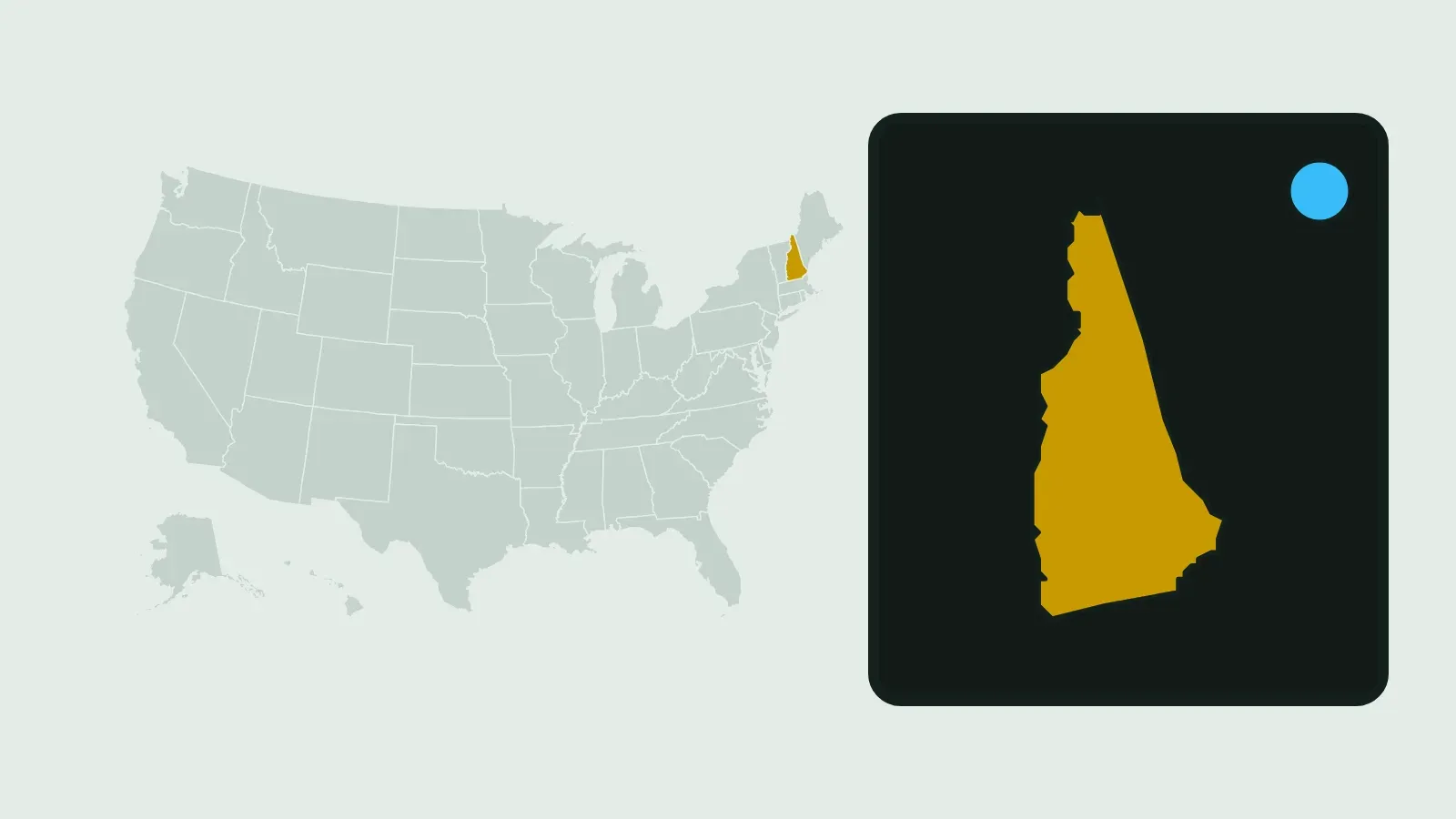
At a glance
New Hampshire households paid an average of 24.53¢ per kWh for electricity in 2025, about 42% above the national average, and $18.61 per thousand cubic feet for natural gas, also above it. Customers can buy electricity from competitive suppliers, but most residential customers stay on utility default service. The Public Utilities Commission's net metering rules cover systems up to 1 megawatt. The state's HOMES and HEAR pages, last updated in 2024, say the rebates are not open.
New Hampshire at a glance
What New Hampshire households pay for electricity and gas
The U.S. Energy Information Administration (EIA) publishes a statewide average for each fuel: what utilities and suppliers billed households, divided by what they used. Delivery charges and fees are inside the number. Your own rate depends on your utility, your supplier and the season, so read these as a yardstick, not a quote.
| Average price | 2024 | 2025 |
|---|---|---|
| Electricity, New Hampshire (¢ per kWh) | 23.40 | 24.53 |
| Electricity, U.S. (¢ per kWh) | 16.48 | 17.23 |
| Natural gas, New Hampshire (dollars per Mcf) | 18.74 | 18.61 |
| Natural gas, U.S. (dollars per Mcf) | 14.50 | 15.34 |
At 24.53¢, a month with 1,000 kWh of use comes to about $245.30. The New Hampshire average rose about 5% between 2024 and 2025. Gas was about 21% above the U.S. average in 2025, and one Mcf holds roughly 10.37 therms, so $18.61 per Mcf is about $1.79 per therm. The kWh, therm and ccf guide explains the units on your bill.
Who sells you electricity
In 1996 the Legislature passed RSA 374-F, which told the Public Utilities Commission (PUC) to draw up a restructuring plan with the goal of retail choice for all customers. The PUC issued that plan in February 1997. Today customers can buy electricity from competitive suppliers inside their utility's franchise area. Most residential customers still take the utility's default energy service, according to the New Hampshire Department of Energy.
- Eversource: serves about 71% of customers.
- New Hampshire Electric Cooperative (NHEC): about 11%. The state calls it a rural cooperative that is not considered a public utility.
- Unitil (UES): about 10%.
- Liberty: about 6%.
The four distribution companies serve separate, non-overlapping territories, so you cannot pick your delivery company. The retail choice guide shows how to compare a supplier's offer with the default rate on your total bill.
Solar panels and net metering
The PUC's net metering rules, Chapter Puc 900, cover customer-owned renewable generation of up to 1 megawatt. A "small" customer-generator is one up to 100 kilowatts AC. Utilities must offer net metering on request, and each utility has a capacity cap for the standard tariff.
What exports earn was reviewed in docket DE 22-060. In its November 18, 2024 order the PUC kept existing compensation in place while it opens further proceedings. For small customers, that means monthly exports earn a credit for 100% of the default service and transmission charges and 25% of the distribution charge. The order also kept the 2040 end date for the legacy arrangement and let utilities charge application fees starting January 1, 2025.
The federal tax credit for rooftop solar ended for systems finished after December 31, 2025. What happened to 25C and 25D explains what is left.
Home energy rebates
The New Hampshire Department of Energy lists two federally funded programs: HOMES for whole-home efficiency work and HEAR for electric appliances and equipment. Its HOMES page, last updated June 26, 2024, says funding "is not available to NH consumers." Its HEAR page, last updated May 1, 2024, says the same and lists $34,749,580 for the state through September 2031.
Those pages show draft amounts, which the state said could change: up to $14,000 combined per household for HEAR, and for HOMES up to $4,000 per single-family home, or $8,000 for low- and moderate-income households. The pages give no launch date. In May 2026 the U.S. Department of Energy issued new HOMES and HEAR guidance, and states that had not launched must meet it first. Until the state posts a newer status, treat any contractor's claim that New Hampshire rebate money is available as unconfirmed. The HOMES and HEAR guide explains how the programs work where they are open.
Other state programs for homeowners
The Department of Energy's homeowner funding page also lists a Solar Rebate Program and a Home Heating Wood Pellet Rebate Program, along with a link to the NHSaves utility efficiency programs. The page gives no terms for them, so open it for current amounts and deadlines before you plan around one.
Who to call
- Electricity: the New Hampshire Public Utilities Commission and the Department of Energy both regulate electric utility services and rates.
- Net metering questions: your distribution utility applies the tariff; the PUC sets the rules.
- Rebates: the New Hampshire Department of Energy.
Quick answers
Can I choose my electricity supplier in New Hampshire?
Yes. Customers can buy from competitive suppliers within their utility's area, though most residential customers stay on the utility's default service. You cannot choose the company that delivers the power.
Does New Hampshire have net metering?
Yes, for customer-owned renewable systems up to 1 megawatt, under PUC rules. What exports earn is set by the PUC, and its November 2024 order kept existing compensation while further proceedings continue.
Are New Hampshire home energy rebates available now?
The state's HOMES and HEAR pages, last updated in 2024, say funding is not available to consumers. Check the Department of Energy before you start work you hope a rebate will cover.
Why is my New Hampshire electricity price above the U.S. average?
EIA's 2025 average for New Hampshire households was 24.53¢ per kWh against 17.23¢ nationally. The figure includes delivery charges and fees. Your own bill shows how your rate is built; the electric bill guide walks through the lines.
Sources
- EIA — Electric Power Annual, Table 2.10, average price by state
- EIA — Average residential natural gas price by state
- NH Department of Energy — Electric utilities
- NH PUC — Order No. 27074, Docket DE 22-060 (November 18, 2024)
- NH Code of Administrative Rules — Chapter Puc 900, net metering
- NH Department of Energy — Home Efficiency Rebates Program
- NH Department of Energy — Home Electrification and Appliance Rebates
- NH Department of Energy — Funding opportunities for homeowners
- U.S. Department of Energy — Program Notice 26-1 (HOMES)
Prices are EIA statewide averages. Facts on this page were checked against these sources on November 19, 2026. The state's rebate pages carry 2024 update dates; net metering compensation and rebate programs change, so confirm with your utility and the Department of Energy before you act.
Read next
-
Bill guide
Net metering
How exported solar power is credited on a bill, how net billing differs, and where to find your rule.
-
Credits and rebates
HOMES and HEAR rebates
State-run DOE rebates and the May 2026 rule changes. Status differs by state.
-
State reading
New Jersey
22.48¢ per kWh; every customer can pick a supplier; net metering at retail value; rebates not open yet.