Low
Home energy in Nebraska: prices, public power and rebate status
Nebraska electricity and gas are both well below the U.S. average. Each area has one exclusive electric utility, the state has no retail electric competition, and its home energy rebates have not opened.
By VoltHearth Editorial Team Updated 6 min read
- Electricity price
- 12.05¢ per kWh
- Natural gas price
- $11.40 per Mcf
- Pick your supplier
- No retail competition
- Net metering
- Yes; avoided-cost credit
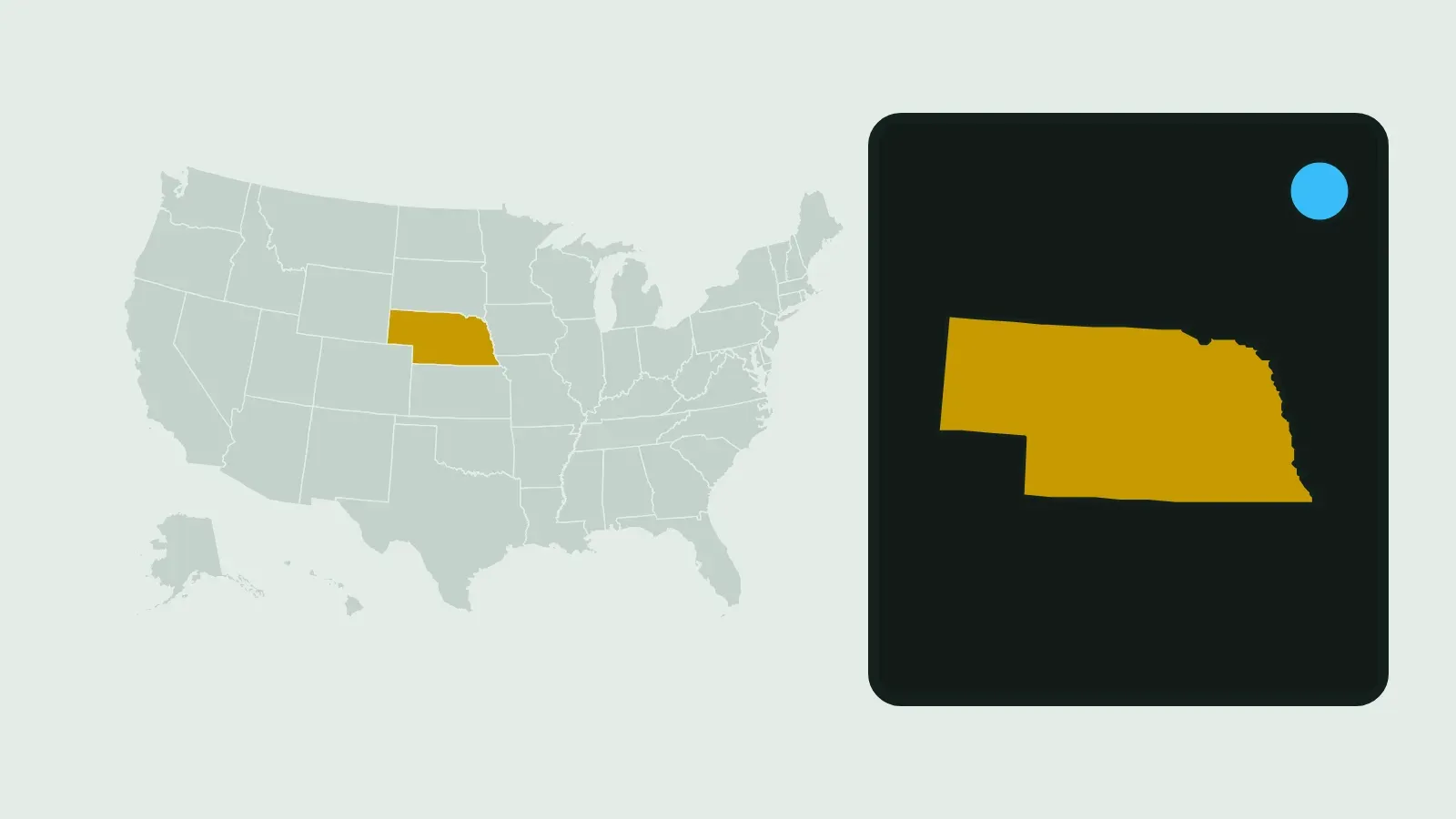
At a glance
Nebraska households paid an average of 12.05¢ per kWh for electricity in 2025, about 30% below the national average, and $11.40 per thousand cubic feet for natural gas, about 26% below it. The Power Review Board says Nebraska does not allow retail competition among electric suppliers: each designated service area has one exclusive utility. State law requires net metering, with exports credited at the utility's avoided cost. The state's rebate programs are listed as "Preparing Application".
Nebraska at a glance
What Nebraskans pay for electricity and gas
The U.S. Energy Information Administration (EIA) reports statewide averages: total residential revenue divided by kilowatt-hours sold, so delivery charges and fees are inside the figure. Your own rate depends on your utility and rate class, so treat these as a yardstick, not a quote.
| Energy | Nebraska 2025 | Nebraska 2024 | U.S. 2025 |
|---|---|---|---|
| Electricity (¢ per kWh) | 12.05 | 11.53 | 17.23 |
| Natural gas (dollars per Mcf) | 11.40 | 10.63 | 15.34 |
At 12.05¢, a month with 1,000 kWh of use comes to $120.50. Nebraska electricity rose about 5% between 2024 and 2025 (11.53¢ to 12.05¢) and is about 30% below the U.S. average. Gas rose about 7% to $11.40 per Mcf. One Mcf holds roughly 10.37 therms, so $11.40 per Mcf is about $1.10 per therm; the kWh, therm and ccf guide explains the units on your bill.
Who sells you electricity
The Nebraska Power Review Board states that "Nebraska currently does not allow retail competition among electric suppliers operating in the State." Service is organized by designated retail service areas, and each area's electric utility has the exclusive right to serve its customers. Nebraska's suppliers are public power districts, municipalities, electric membership associations and cooperatives, according to the state's power policy statute and the Board's biennial report.
So you do not shop for a plan. Your address decides your utility, and your bill names it. For questions about your rate, call that utility. For how bills are built, see the rate structures guide.
Solar panels and what the grid pays you
Nebraska's net metering statute, section 70-2003, requires the local distribution utility to provide net metering to a customer-generator with a qualified facility and an interconnection agreement. The text reviewed cites Laws 2009, LB 436; VoltHearth could not confirm whether later amendments exist.
- Credit for exports: net excess generation in a billing period is credited at the utility's avoided cost of electricity supply and carries forward to later bills.
- Year-end payout: remaining credits are paid out with the final bill of each annualized period, or within 60 days after you end retail service.
- Program cap: a utility need not add net metering customers once their combined capacity reaches 1% of the capacity needed to meet its average aggregate monthly peak demand forecast.
- Larger units: the statute also lets a utility offer net metering for renewable units rated above 25 kilowatts through other arrangements.
Avoided cost is a wholesale-type rate, so exports are worth less than the retail rate. Run your own numbers in the solar payback calculator and read the net metering guide. The federal tax credit ended for systems finished after December 31, 2025; see what happened to 25C and 25D.
Home energy rebates
The Nebraska Department of Water, Energy, and Environment (DWEE) will run the federal home energy rebates. Its energy programs page lists both the high-efficiency electric home rebate (HEAR) and the whole-house performance-based rebate (HOMES) as "Preparing Application". The page is undated and gives no opening date, so neither program is open.
A DWEE release dated October 13, 2023 said the funds were not yet available. It described plans to apply for about $91 million across two grants, with about 40% going to low-income households, and listed maximums of up to $14,000 for HEAR and up to $8,000 for HOMES, the latter for low-income households. That release is old and describes plans, so it is not a status report. How the programs work is in the HOMES and HEAR guide.
Public power and retail competition
State policy in section 70-1001 aims for "adequate and reliable electric service at as low overall cost as possible", seeks to avoid duplicate facilities and competition among its public suppliers, and says the state intends to prepare for retail competition only if conditions show it would benefit citizens. The Power Review Board describes this as a "conditions certain" approach with no date set for competition. The Board approves new generation facilities, retail service area changes and public power district charter amendments.
Who to call
- Electric service areas and new generation: the Nebraska Power Review Board.
- Your rate and net metering terms: your public power district, municipal utility or cooperative.
- Rebates: the Nebraska Department of Water, Energy, and Environment.
Quick answers
Can I choose my electricity provider in Nebraska?
No. The Power Review Board says Nebraska does not allow retail competition among electric suppliers. Each designated service area has one electric utility with the exclusive right to serve it.
Does Nebraska have net metering?
Yes, under state statute 70-2003. Exports are credited at the utility's avoided cost, and remaining credits are paid out at the end of each annualized period.
Are Nebraska home energy rebates available now?
No. The state's energy programs page lists both programs as "Preparing Application" with no opening date. Check the Department of Water, Energy, and Environment before planning work around a rebate.
Why is Nebraska electricity so far below the U.S. average?
EIA's 2025 average for Nebraska households was 12.05¢ per kWh against 17.23¢ nationally. EIA reports the figure but not the reasons; the state's public power policy aims for low overall cost, though the sources reviewed do not link it to the price.
Sources
- EIA — Electric Power Annual, Table 2.10, average price by state
- EIA — Average residential natural gas price by state
- Nebraska Power Review Board — Deregulation activities
- Nebraska Revised Statute 70-1001 — Electric service policy
- Nebraska Revised Statute 70-2003 — Net metering
- Nebraska DWEE — Energy programs status
- Nebraska DWEE — Home energy rebates release (October 13, 2023)
Prices are EIA statewide averages. Facts on this page were checked against these sources on November 19, 2026. The net metering text reviewed cites Laws 2009. Rebate programs and utility policies change; confirm with your utility and the Department of Water, Energy, and Environment before you act.
Read next
-
Bill guide
Net metering
How exported solar power is credited on a bill, how net billing differs, and where to find your rule.
-
Credits and rebates
HOMES and HEAR rebates
State-run DOE rebates and the May 2026 rule changes. Status differs by state.
-
State reading
Iowa
13.62¢ per kWh; your utility sells the power; net billing or inflow-outflow; rebates not open on last update.