Moderate
Home energy in Minnesota: prices, solar credits and what is open
Minnesota electricity sits below the U.S. average and gas well below it. Solar export credits depend on system size and whether your utility is investor-owned, a co-op or a city, and the state's rebates have not launched.
By VoltHearth Editorial Team Updated 6 min read
- Electricity price
- 15.83¢ per kWh
- Natural gas price
- $10.98 per Mcf
- Pick your supplier
- Not confirmed
- Net metering
- Yes; rules vary by utility
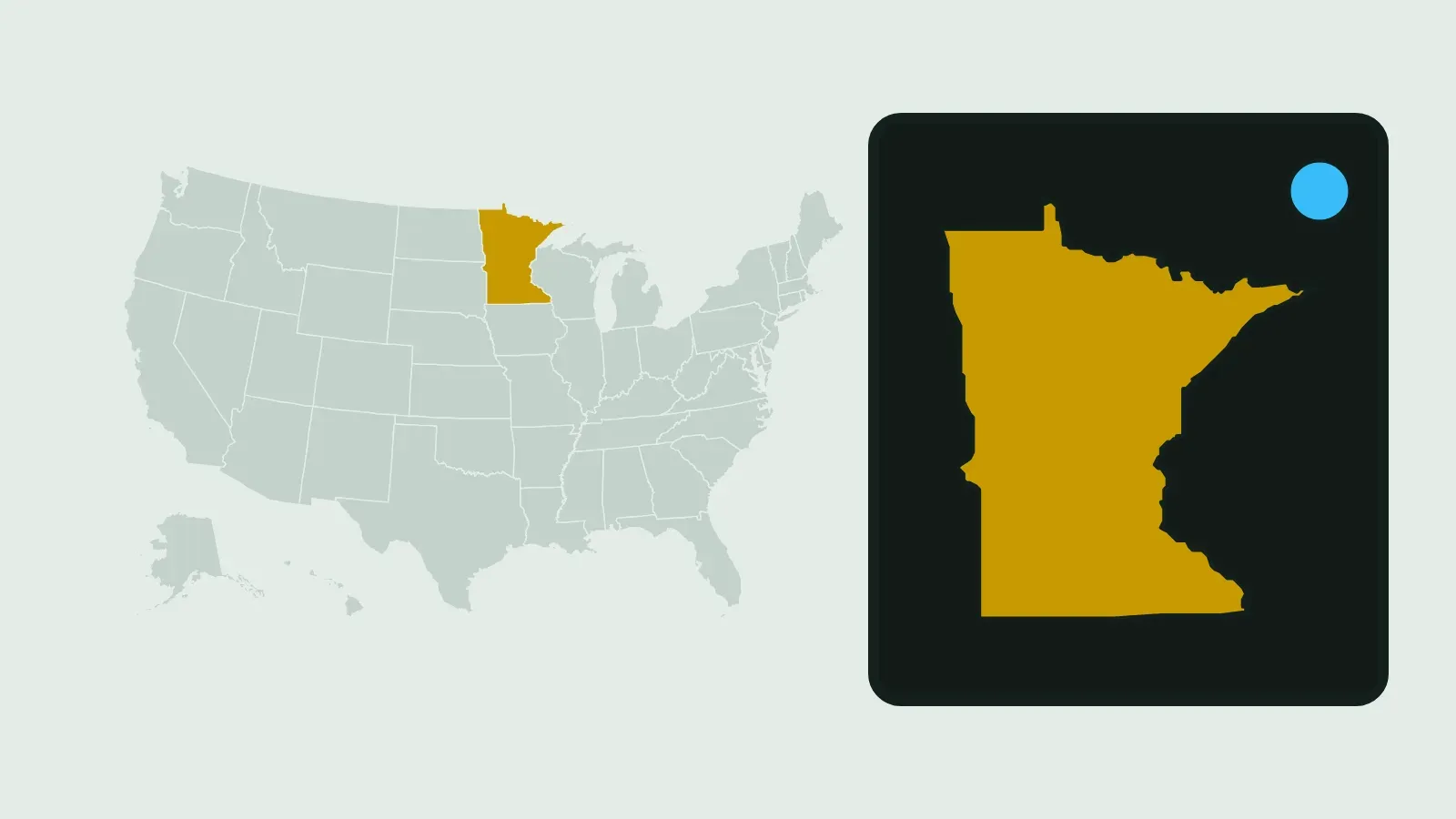
At a glance
Minnesota households paid an average of 15.83¢ per kWh for electricity in 2025, below the national average, and $10.98 per thousand cubic feet for natural gas, well below it. State law sets net metering rules for rooftop solar, with the best-defined credit for systems under 40 kW. The state's HOMES and HEAR rebates, branded Save Energy Minnesota, had not launched on the Department of Commerce's October 12, 2026 update, and no launch date was set.
Minnesota at a glance
What Minnesotans pay for electricity and gas
The U.S. Energy Information Administration (EIA) reports statewide averages: total residential revenue divided by kilowatt-hours sold, so delivery charges and fees are inside the figure. Your own rate depends on your utility and rate class, so treat these as a yardstick, not a quote.
| Energy | Minnesota 2025 | Minnesota 2024 | U.S. 2025 |
|---|---|---|---|
| Electricity (¢ per kWh) | 15.83 | 15.45 | 17.23 |
| Natural gas (dollars per Mcf) | 10.98 | 10.65 | 15.34 |
At 15.83¢, a month with 1,000 kWh of use comes to about $158. Minnesota electricity rose about 2% between 2024 and 2025 (15.45¢ to 15.83¢) and sits about 8% below the U.S. average. Gas is cheaper still: Minnesota households paid about 28% less per Mcf than the U.S. average. One Mcf holds roughly 10.37 therms, so $10.98 per Mcf is about $1.06 per therm; the kWh, therm and ccf guide explains the units on your bill.
Who sells you electricity
Minnesota's Public Utilities Commission (PUC) lists rate cases for investor-owned utilities such as Xcel Energy and Otter Tail Power, and its net metering page also covers cooperative and municipal utilities. So your power may come from any of the three, depending on your address, and your bill names the utility.
The PUC pages reviewed for this article do not describe a program that lets homes pick a different electricity supplier, and VoltHearth could not confirm one from a state source. If a company offers to switch your electric supplier, ask your utility and the PUC before you agree. For how retail choice works in states that have it, see the retail choice guide.
Solar panels and what the grid pays you
Minnesota's net metering rules are in state law and summarized on the PUC's distributed energy pages (last modified September 1, 2026). The rate you get for exports depends on size and utility type.
- Under 40 kW AC: exports earn the utility's average retail energy rate, which the utility updates each year. The PUC describes it as yearly revenue minus fixed charges, divided by kilowatt-hours sold.
- Larger systems: public utility customers under 1 MW get simultaneous purchase and sale rates, usually lower than the average retail rate. Public utility systems from 1 to 20 MW negotiate on the utility's avoided cost.
- Co-ops and municipals: thresholds are smaller (40 kW and 100 kW) and these utilities may charge a fixed-cost fee on solar customers. Their unused year-end credits are canceled with no payment, while public utilities pay for them at avoided cost.
- Size limit: a system generally cannot exceed 120% of the energy used at the property or meter.
Ask your utility which category you fall in, then use that rate in the solar payback calculator. The net metering guide covers the credit methods. The federal tax credit for rooftop solar ended for systems finished after December 31, 2025; see what happened to 25C and 25D.
Home energy rebates
The Minnesota Department of Commerce will run HOMES and HEAR as Save Energy Minnesota. Its October 12, 2026 update says the program has not launched, is waiting for formal approval from the U.S. Department of Energy, and has no estimated launch date. New DOE rules may change how the rebates work, and Commerce is still assessing them. Rebates cannot be applied to purchases made before launch.
| Program and income | Largest listed amount |
|---|---|
| HEAR, income at or below 80% of area median | $14,000 per household |
| HEAR, income 80% to 150% of area median | $7,000 per household |
| HOMES, 35% or more modeled savings, below 80% | Lesser of $12,000 or 100% of cost |
| HOMES, 35% or more modeled savings, 80% to 150% | Lesser of $8,000 or 80% of cost |
These are the figures Commerce listed on its pages and could change. How the programs work elsewhere is in the HOMES and HEAR guide.
A scam warning before the rebates launch
Commerce warns that unexpected calls, emails, texts, ads or door-to-door offers about the program are likely scams. Its consumer advisory No. 2024-001 was issued September 9, 2025, updated December 9, 2025, and expires January 12, 2027. Since no rebate is available yet, nobody can sign you up for one today.
Who to call
- Electricity and natural gas: the Minnesota Public Utilities Commission, which lists both electric and gas rate cases.
- Rebates: the Minnesota Department of Commerce, Energy Division, which runs Save Energy Minnesota.
Quick answers
Can I choose my electricity provider in Minnesota?
VoltHearth could not confirm a retail choice program for homes from a state source. Your utility is named on your bill; ask it and the Public Utilities Commission before agreeing to any offer to change suppliers.
Does Minnesota have net metering?
Yes, under state law. Systems under 40 kW AC are paid the utility's average retail energy rate for exports. Larger systems, co-ops and municipal utilities follow different rules, so ask your utility.
Are Minnesota home energy rebates available now?
No. Commerce's October 12, 2026 update says Save Energy Minnesota has not launched and has no estimated launch date. Rebates cannot be applied to purchases made before launch.
Why is Minnesota gas cheaper than the U.S. average?
EIA's 2025 average for Minnesota households was $10.98 per Mcf against $15.34 nationally. The figure blends supply, delivery and fixed charges across the state, and your own rate depends on your gas utility.
Sources
- EIA — Electric Power Annual, Table 2.10, average price by state
- EIA — Average residential natural gas price by state
- Minnesota PUC — Net metering
- Minnesota PUC — Distributed energy
- Minnesota Department of Commerce — HEAR program
- Minnesota Department of Commerce — HOMES program
Prices are EIA statewide averages. Facts on this page were checked against these sources on November 19, 2026. Rebate programs and utility policies change; confirm with your utility and the Department of Commerce before you act.
Read next
-
Bill guide
Net metering
How exported solar power is credited on a bill, how net billing differs, and where to find your rule.
-
Credits and rebates
HOMES and HEAR rebates
State-run DOE rebates and the May 2026 rule changes. Status differs by state.
-
State reading
Wisconsin
18.08¢ per kWh; utility supplies power; net metering varies; HOMES and HEAR rebates open.