Highest
Home energy in Hawaii: prices, who sells you power and what is open
Hawaii's average electricity price is the highest among the states on this site. Each island has its own grid, net metering is closed to new applicants, and the state's home energy rebates have not opened.
By VoltHearth Editorial Team Updated 6 min read
- Electricity price
- 40.40¢ per kWh
- Natural gas price
- $52.38 per Mcf
- Pick your supplier
- Utility by island
- Net metering
- Closed; newer programs
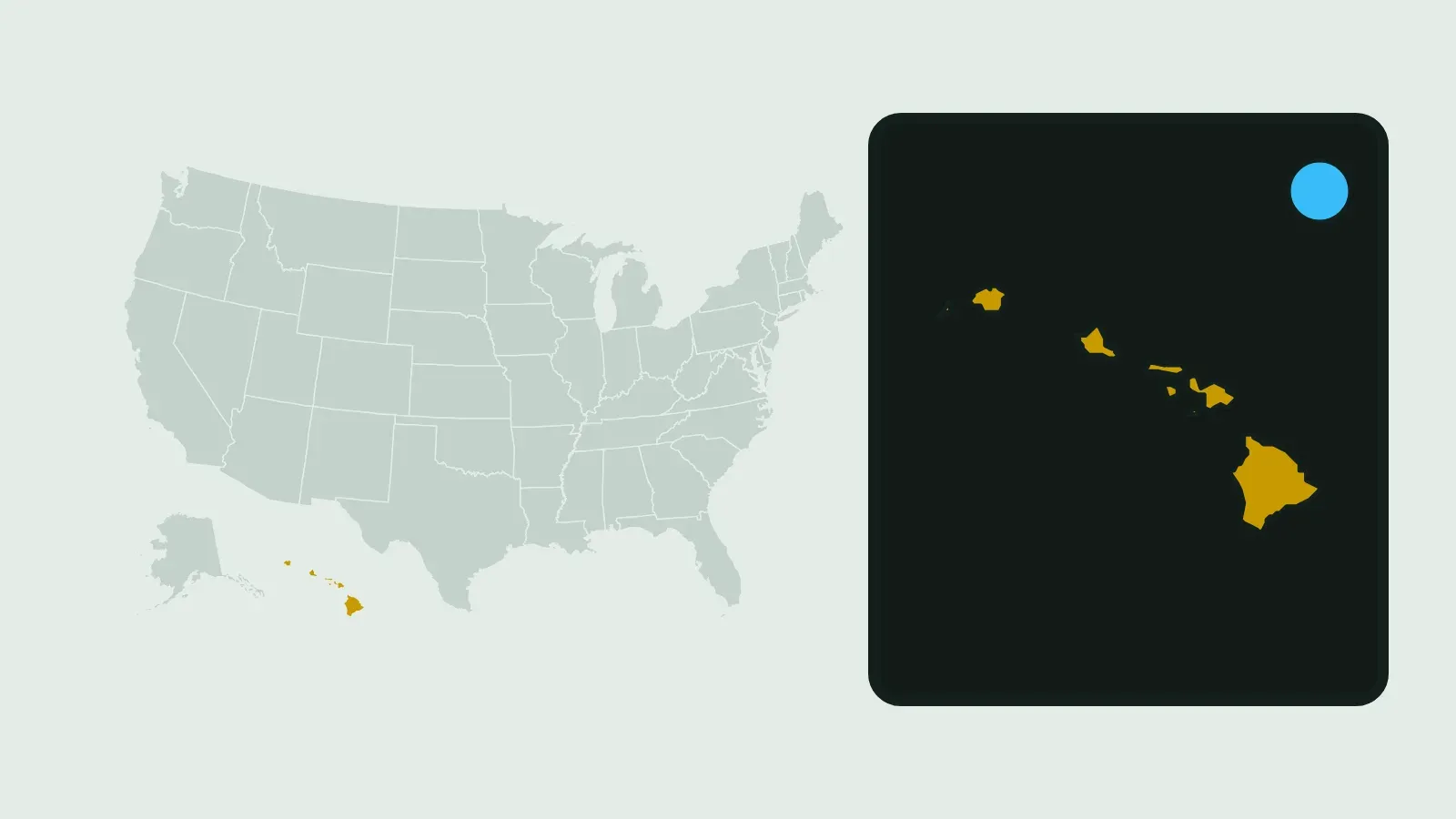
At a glance
Hawaii households paid an average of 40.40¢ per kWh for electricity in 2025, more than twice the national average, and $52.38 per thousand cubic feet for natural gas, about three and a half times it. Hawaiian Electric serves about 95% of residents, and petroleum fueled 65% of the state's electricity in 2024. Net energy metering is closed to new applicants, and the state's eHale Energy Saver rebates were pending federal approval to launch on the state energy office's page.
Hawaii at a glance
What Hawaii households pay for electricity and gas
The U.S. Energy Information Administration (EIA) reports statewide averages: total residential revenue divided by kilowatt-hours sold, so delivery charges and fees are inside the figure. Your own rate depends on your utility and rate plan, so treat these as a yardstick, not a quote.
| Energy | Hawaii 2025 | Hawaii 2024 | U.S. 2025 |
|---|---|---|---|
| Electricity (¢ per kWh) | 40.40 | 42.86 | 17.23 |
| Natural gas (dollars per Mcf) | 52.38 | 48.88 | 15.34 |
At 40.40¢, a month with 1,000 kWh of use comes to about $404. Hawaii electricity fell about 6% between 2024 and 2025 (42.86¢ to 40.40¢) but still ran about 2.3 times the U.S. average. Gas went the other way: it rose about 7% from 2024 and was about 3.4 times the U.S. average. One Mcf holds roughly 10.37 therms, so $52.38 per Mcf is about $5.05 per therm; the kWh, therm and ccf guide explains the units on your bill.
Who sells you electricity
EIA says Hawaiian Electric serves about 95% of Hawaii residents and operates on five of the state's six main islands. An electric cooperative serves Kauai. The islands are not linked by undersea cables, so each one runs its own grid and generates its own power.
Your island and address decide your utility, and the name is at the top of your bill. To check what each line means, use the electric bill guide and your utility's published rate schedule.
Why Hawaii power costs more
EIA's Hawaii profile, last updated May 15, 2025, ties the state's high prices to imported petroleum and to its isolated island grids.
- Petroleum: it fueled 65% of Hawaii's electricity generation in 2024, and about 90% of the state's total energy consumption (the page's endnote cites 2022 data), the highest share of any state.
- Renewables: they supplied about one-third of statewide generation in 2024.
- Island by island: the Big Island has the state's only geothermal plant, and the state's largest solar farm, about 60 MW on Maui, came online in mid-2024.
Higher power prices also change the arithmetic of efficiency. An appliance that uses 1 kWh costs 40.40¢ at the statewide average, so the appliance running cost tool shows differences that would look small in a cheaper state.
Solar panels and what the grid pays you
Hawaiian Electric's page says its Net Energy Metering (NEM) program "is Closed to New Applicants." Customers with a current NEM agreement, and those with complete applications submitted before October 13, 2015, stay on NEM. Net metering is the practice of crediting excess solar power at the retail rate.
The same page lists newer rooftop programs: Smart Renewable Energy Export, Smart Renewable Energy Non-Export and Shared Solar, and a set of earlier ones that includes Customer Grid-Supply Plus, Smart Export and Customer Self-Supply. The page does not state how exports are credited, so this site does not give a rate. In August 2025 the Hawaii Public Utilities Commission closed its long-running investigation into distributed energy resource policies and listed Smart DER and BYOD Plus among existing programs.
The federal tax credit for rooftop solar ended for expenditures made after December 31, 2025. What happened to 25C and 25D explains what is left.
Home energy rebates
The Hawai‘i State Energy Office runs the eHale Energy Saver program, the state's version of the federally funded HOMES and HEAR rebates. Its page says the program is "Currently Pending US Department of Energy Approval of launch," that no applications are being accepted, and that both pathways "will be available to Hawaiʻi residents in early 2027." The same page lists the electrification rebate, HEEHR, as "Coming Soon" with funding "expected 2026," so its own dates do not agree.
- HEEHR (electrification): based on household income, up to 150% of area median income (AMI). The page says up to 100% of eligible project cost below 80% AMI and up to 50% from 80% to 150% AMI.
- HOMES (whole-home efficiency): listed as pending federal funds, with approval timing "currently unknown." The page says up to 100% of eligible project cost below 80% AMI and up to 50% at 80% AMI and above.
- Dollar limits: the page states percentages, not dollar caps or funding totals.
Households enrolled in programs such as Medicaid, SNAP, SSI or public housing are recognized for income eligibility. Do not sign anything that depends on a rebate until the state opens applications. How the programs work in states where they have launched is in the HOMES and HEAR guide.
Who to call
- Electricity: the Hawaii Public Utilities Commission.
- Rebates: the Hawai‘i State Energy Office, 235 S. Beretania Street, 5th Floor, Honolulu, at (808) 587-3807.
- Your own rate: your utility's tariff, which names your plan and its charges.
Quick answers
Why is Hawaii electricity so expensive?
EIA's 2025 average for Hawaii households was 40.40¢ per kWh against 17.23¢ nationally. EIA ties the high prices to imported petroleum, which fueled 65% of the state's 2024 generation, and to separate island grids.
Does Hawaii have net metering?
Hawaiian Electric's NEM program is closed to new applicants. Customers with a current NEM agreement, or a complete application before October 13, 2015, stay on it. Newer programs exist; ask your utility for the current export credit.
Are Hawaii home energy rebates available now?
Not yet. The State Energy Office's eHale page says the program is pending federal approval to launch and that both pathways will be available in early 2027. Check that page for updates.
Can I choose my electricity supplier in Hawaii?
Your island and address decide your utility. Hawaiian Electric serves about 95% of residents, an electric cooperative serves Kauai, and the name of your utility is at the top of your bill.
Sources
- EIA — Electric Power Annual, Table 2.10, average price by state
- EIA — Average residential natural gas price by state
- EIA — Hawaii state profile and energy estimates
- Hawai‘i State Energy Office — eHale Energy Saver home energy rebate program
- Hawaii Public Utilities Commission — news release on distributed energy resources (August 8, 2025)
- Hawaiian Electric — Net Energy Metering and previous renewable programs
Prices are EIA statewide averages. Facts on this page were checked against these sources on November 19, 2026. Rebate programs and utility policies change; confirm with your utility and the Hawai‘i State Energy Office before you act.
Read next
-
Bill guide
Net metering
How exported solar power is credited on a bill, how net billing differs, and where to find your rule.
-
Upgrade
Rooftop solar
What a system makes, how exports are credited, and how to work out payback without the 25D credit.
-
State reading
Alaska
26.11¢ per kWh; utility-set rates; net metering up to 25 kW; most home rebates not launched.